

.svg)

Key takeaways
- An optionally convertible debenture (OCD) is a debt instrument under which the holder has the right, but not the obligation, to convert the debenture into equity shares at a predetermined price. If the holder does not convert, the debenture is redeemed at maturity on the terms set out in the debenture agreement.
- The existence of a cash-repayment path is the defining difference between an OCD and a compulsorily convertible debenture (CCD). Under a CCD, cash repayment is not permitted.
- Under FEMA, OCDs are classified as debt, not equity. They do not qualify as FDI capital instruments. Foreign investors receiving OCDs from an Indian company must comply with External Commercial Borrowing (ECB) norms rather than FDI norms.
- The issuance of OCDs to new investors requires compliance with Section 71, Section 42, and, where conversion into equity is involved, Section 62(1)(c) of the Companies Act, 2013.
- Unlike CCDs, OCDs require the creation of a Debenture Redemption Reserve (DRR), because cash redemption remains a possible outcome. For unlisted companies issuing OCDs through private placement, the DRR is set at 10% of the value of outstanding debentures under Rule 18(7)(b)(iv)(B) of the Companies (Share Capital and Debentures) Rules, 2014.
- Under Ind AS 32 (paragraph 29), OCDs are compound financial instruments. The issuing company must recognise the liability component and the equity component separately and present them independently on the balance sheet.
What is an optionally convertible debenture?
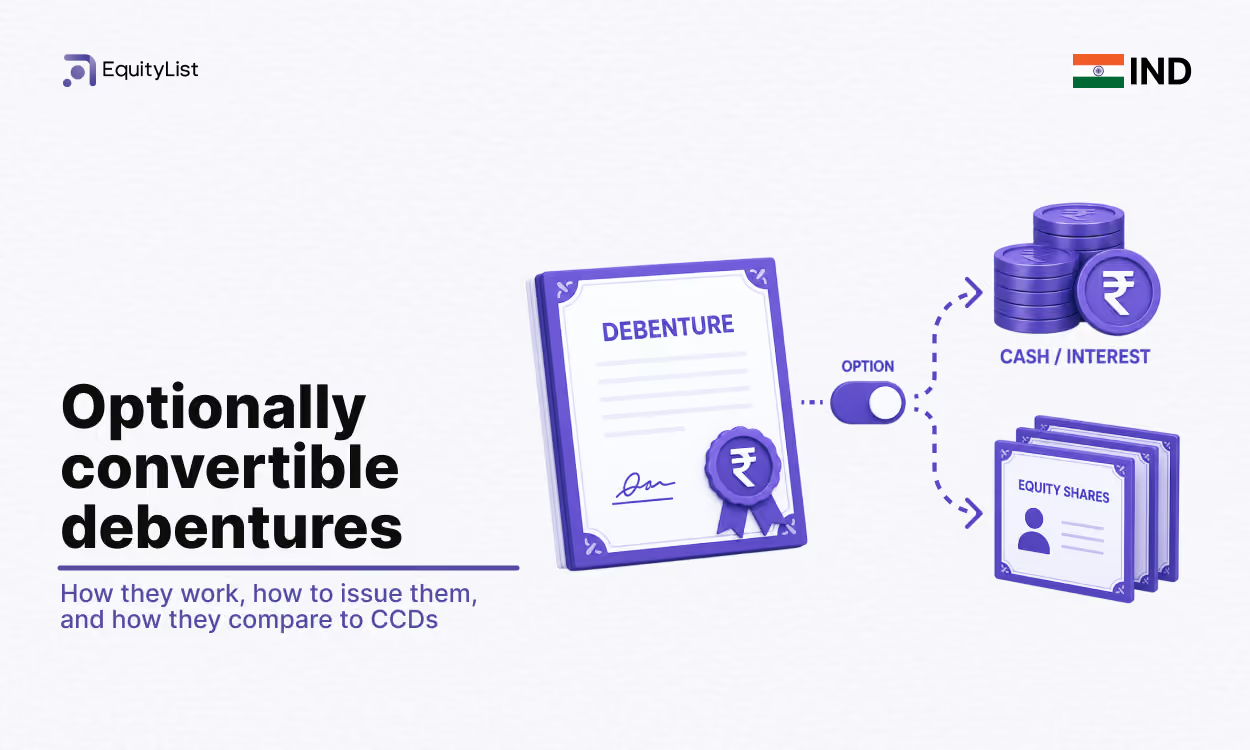
An optionally convertible debenture (OCD) is a debt instrument that gives the holder the right, but not the obligation, to convert the debenture into equity shares of the issuing company at a predetermined price. If the holder does not exercise that option, the company redeems the debenture in cash at maturity.
OCDs are authorised under Section 71(1) of the Companies Act, 2013, which permits companies to issue debentures with an option to convert into shares, wholly or in part, at the time of redemption. The proviso to that section requires shareholder approval by special resolution before any such debentures can be issued.
The instrument sits alongside two better-known debenture types: non-convertible debentures (NCDs), which are pure debt with no equity path, and compulsorily convertible debentures (CCDs), where conversion into equity is mandatory. OCDs occupy the middle ground: they begin as debt and may become equity, but only if the holder chooses.
How OCDs work
The company receives funds from the investor and issues a debenture on terms set out in the debenture agreement, including the interest rate and tenure. On or before the maturity date, the holder decides whether to convert the debenture into equity shares at the pre-agreed conversion price, or to redeem it on the terms specified in the agreement.
The conversion price can be fixed at issuance or determined by a formula specified at issuance, such as a discount to the valuation at a subsequent funding round.
How OCDs are classified across different laws
Classification under the Companies Act, 2013
Section 71 of the Companies Act, 2013 governs the issuance of debentures, including OCDs. The Act defines "debenture" under Section 2(30) of Companies Act, 2013 as any instrument of a company evidencing a debt. Section 71(2) further provides that debentures cannot carry voting rights, which distinguishes them structurally from equity shares.
Classification under FEMA and the FDI framework
Under the Foreign Exchange Management (Non-Debt Instruments) Rules, 2019, capital instruments eligible for Foreign Direct Investment are defined to include equity shares, CCPS, and CCDs. The definition turns on the word "compulsorily": only instruments that are fully and mandatorily convertible into equity qualify. OCDs, which contemplate the possibility of cash repayment, fall outside this definition and are classified as debt under FEMA.
An Indian company cannot raise funding from a foreign investor through OCDs and treat it as FDI. Because OCDs do not qualify as capital instruments under the FEM (NDI) Rules, 2019, such an investment must follow the ECB route instead.
Classification under the Income Tax Act, 1961
For income tax purposes, interest paid by the company on OCDs is deductible under Section 36(1)(iii) of the Income Tax Act, 1961 as interest on borrowed capital.
Accounting treatment under Ind AS 32
For companies reporting under Indian Accounting Standards, an OCD cannot be recorded simply as a loan. Because the instrument contains both a debt obligation and a conversion option, Ind AS 32 (paragraph 29) requires the issuer to split it into two parts and present them separately on the balance sheet: one representing the financial liability (deliver cash or financial asset), and one representing the equity (option to convert).
How to issue OCDs in India
The issuance of OCDs by a private company draws on multiple sections of the Companies Act, 2013.
a. Board resolution: The board passes a resolution authorising the issuance, specifying the number of debentures, conversion terms, tenure, interest rate, and proposed allottees. Notice of the board meeting must be given at least seven days in advance.
b. Shareholder special resolution: Section 71(1) requires a special resolution, meaning votes cast in favour must be at least three times votes cast against. The resolution must specify the material terms of the issuance.
c. Section 42 and Section 62(1)(c) compliance: When OCDs are issued to new investors through preferential allotment, the company must also comply with Section 42 (private placement) and Section 62(1)(c). Section 42 requires a PAS-4 offer letter within 30 days of the general meeting resolution, a separate bank account for subscription monies, and allotment within 60 days of receipt of funds. Section 62(1)(c), which applies because the debentures convert into equity, requires the conversion price to be supported by a registered valuer's report.
d. Post-allotment filings: Form PAS-3 (return of allotment) must be filed with the RoC within 15 days of allotment. Form MGT-14 is required for the special resolution within 30 days of the general meeting. Secured debentures require charge registration under Section 77.
e. Debenture Redemption Reserve: Rule 18(7)(a) of the Companies (Share Capital and Debentures) Rules, 2014 requires the DRR to be created from the company's profits available for dividend. For unlisted companies issuing debentures through private placement, Rule 18(7)(b)(iv)(B) sets the DRR at 10% of the value of outstanding debentures.
Optionally convertible debentures vs compulsory convertible debentures
FAQs on optionally convertible debentures
Is OCD a debt or equity?
An OCD is classified as debt under most Indian regulatory frameworks. Under the Companies Act, OCDs are debentures and carry no voting rights. Under the Income Tax Act, interest on OCDs is deductible as interest on borrowed capital under Section 36(1)(iii). Under Ind AS 32, OCDs are compound financial instruments and must be bifurcated into a liability component and a separate equity component on the balance sheet. So while the conversion option carries an equity character for accounting purposes, OCDs are treated as debt for regulatory and tax purposes.
How to redeem optionally convertible debentures?
Redemption occurs when the holder does not exercise the conversion option and elects to receive cash at maturity. The company pays the face value of the debenture plus any outstanding interest on the maturity date. If the instrument was secured, the charge registered under Section 77 of the Companies Act must be satisfied and the charge record updated with the Registrar of Companies. The DRR balance accumulated during the tenure is available for release to general reserves after redemption.
Can CCDs be converted to OCDs?
Modifying a CCD into an OCD requires more than a contractual amendment. The two instruments have different statutory requirements: CCDs are exempt from the DRR obligation; OCDs are not. CCDs qualify as FEMA capital instruments; OCDs do not. Introducing an optional redemption feature into a CCD would constitute a material change to the instrument, requiring a fresh shareholder special resolution, a new registered valuer report in most cases, re-filing with the RoC, and a reassessment of FEMA compliance if foreign investors are involved.
.png)